The allegations against President Clinton have unsettled many American Christians. He holds a position we honor and uphold in prayer; and he professes to be a Christian. But the trial by mass media—all the talk of moral impropriety and criminality—has led many to believe he betrays the very values and office for which we pray.
We Christians should be accustomed to leaders whose private behavior and public words and actions appear to be at odds. We've been dealing with them for a long time now.
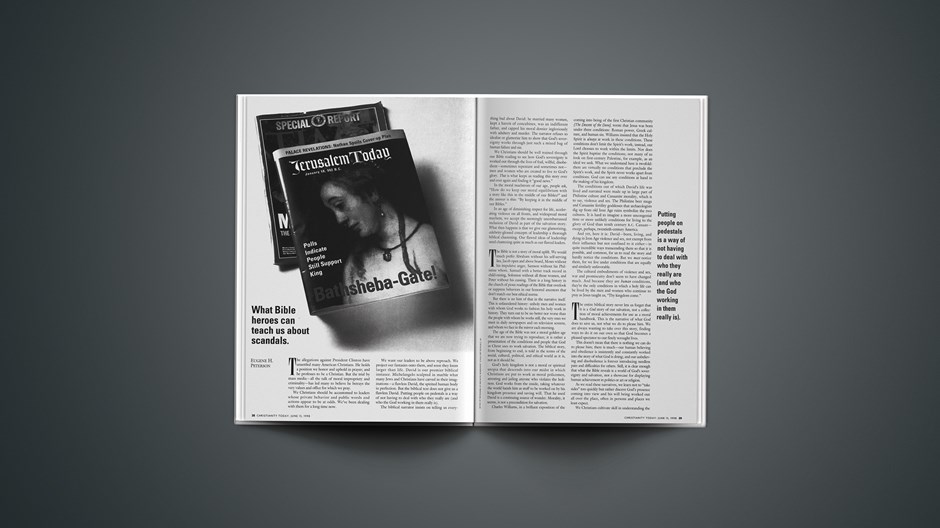
We want our leaders to be above reproach. We project our fantasies onto them, and soon they loom larger than life. David is our premier biblical instance. Michelangelo sculpted in marble what many Jews and Christians have carved in their imaginations—a flawless David, the spirited human body in perfection. But the biblical text does not give us a flawless David. Putting people on pedestals is a way of not having to deal with who they really are (and who the God working in them really is).
The biblical narrator insists on telling us everything bad about David: he married many women, kept a harem of concubines, was an indifferent father, and capped his moral dossier ingloriously with adultery and murder. The narrator refuses to idealize or glamorize him to show that God's sovereignty works through just such a mixed bag of human failure and sin.
We Christians should be well trained through our Bible reading to see how God's sovereignty is worked out through the lives of frail, willful, disobedient—sometimes repentant and sometimes not—men and women who are created to live to God's glory. That is what keeps us reading this story over and over again and finding it "good news."
In the moral maelstrom of our age, people ask, "How do we keep our moral equilibrium with a story like this in the middle of our Bibles?" and the answer is this: "By keeping it in the middle of our Bibles."
In an age of diminishing respect for life, accelerating violence on all fronts, and widespread moral mayhem, we accept the seemingly unembarrassed inclusion of David as part of the salvation story. What then happens is that we give our glamorizing, celebrity-glossed concepts of leadership a thorough biblical chastening. Our flawed ideas of leadership need chastening quite as much as our flawed leaders.
The Bible is not a story of moral uplift. We would much prefer Abraham without his self-serving lies, Jacob open and above board, Moses without his impulsive anger, Samson without his Philistine whore, Samuel with a better track record in child-raising, Solomon without all those women, and Peter without his cussing. There is a long history in the church of pious readings of the Bible that overlook or suppress behaviors in our honored ancestors that don't match our best ethical norms.
But there is no hint of that in the narrative itself. This is unlaundered history: unholy men and women with whom God works to fashion his holy work in history. They turn out to be no better nor worse than the people with whom he works still, the very ones we meet in daily newspapers and on television screens, and whom we face in the mirror each morning.
The age of the Bible was not a moral golden age that we are now trying to reproduce; it is rather a presentation of the conditions and people that God in Christ uses to work salvation. The biblical story, from beginning to end, is told in the terms of the social, cultural, political, and ethical world as it is, not as it should be.
God's holy kingdom is not a moral or spiritual utopia that descends into our midst in which Christians are put to work as moral policemen, arresting and jailing anyone who violates the holiness. God works from the inside, taking whatever the world hands him as stuff to be worked on by his kingdom presence and saving will. That he used David is a continuing source of wonder. Morality, it seems, is not a precondition for salvation.
Charles Williams, in a brilliant exposition of the coming into being of the first Christian community (The Descent of the Dove), wrote that Jesus was born under three conditions: Roman power, Greek culture, and human sin. Williams insisted that the Holy Spirit is always at work in these conditions. These conditions don't limit the Spirit's work; instead, our Lord chooses to work within the limits. Nor does the Spirit baptize the conditions; not many of us look on first-century Palestine, for example, as an ideal we seek. What we understand here is twofold: there are virtually no conditions that preclude the Spirit's work, and the Spirit never works apart from conditions. God can use any conditions at hand in the making of his kingdom.
The conditions out of which David's life was lived and narrated were made up in large part of Philistine culture and Canaanite morality, which is to say, violence and sex. The Philistine beer mugs and Canaanite fertility goddesses that archaeologists dig up from old Iron Age ruins symbolize the two cultures. It is hard to imagine a more uncongenial time or more unlikely conditions for living to the glory of God than tenth century B.C. Canaan—except, perhaps, twentieth-century America.
Article continues below
And yet, here it is: David—born, living, and dying in Iron Age violence and sex, not exempt from their influence but not confined to it either—in quite incredible ways transcending them so that it is possible, and common, for us to read the story and hardly notice the conditions. But we must notice them, for we live under conditions that are equally and similarly unfavorable.
The cultural embodiments of violence and sex, war and promiscuity don't seem to have changed much. And because they are human conditions, they're the only conditions in which a holy life can be lived by the men and women who continue to pray as Jesus taught us, "Thy kingdom come."
The entire biblical story never lets us forget that it is a God story of our salvation, not a collection of moral achievements for use as a moral handbook. This is the narrative of what God does to save us, not what we do to please him. We are always wanting to take over this story, finding ways to do it on our own so that God becomes a pleased spectator to our finely wrought lives.
This doesn't mean that there is nothing we can do to please him; there is much—our human believing and obedience is insistently and constantly worked into the story of what God is doing; and our unbelieving and disobedience is forever introducing needless pain and difficulties for others. Still, it is clear enough that what the Bible reveals is a world of God's sovereignty and salvation, not a showcase for displaying human achievement in politics or art or religion.
As we read these narratives, we learn not to "take sides" too quickly but rather discern God's presence coming into view and his will being worked out all over the place, often in persons and places we least expect.
We Christians cultivate skill in understanding the ways of the world within the far larger context of God's sovereignty, depending on our biblical writers to give us the "sovereignty" perspective. If we get our theology—that is, our understanding of what is really and eternally God-important—from the journalists, we get a few facts, almost no truth, and nothing at all of God. But a biblically trained imagination accustomed to dealing with flawed leaders, discerns our sovereign God working out his salvation purposes in our history. This counters cynicism and even despair as we are handed daily bulletins documenting the failures of our leaders in government and church.
Article continues below
That's what Israel did. Israel developed a most impressive theology of God as king, God alive and present in sovereign justice and mercy during the very five-hundred-year period (from 1000 to 500 B.C.) when their daily experience of kings was most unsatisfactory. "The Lord reigns!" was the key motif in their theology (Pss. 93:1; 97:1; 99:1). Also, the early church cultivated a habit of intercession for the rulers of the day (1 Tim. 2:1-2), most of whom were either ignorant or defiant of the God revealed in Jesus Christ. Neither Israel's God-anointed kings nor Rome's pagan emperors ever gave evidence of a moral life that was much to write home about. One of our ancestors put it so graphically: "God rides the lame horse and draws straight lines with a crooked stick."
The way a leader lives, of course, has enormous effects on a society and culture. Sin cannot be contained in the sinner—it spills out of the self into society, making a mess. And when that happens the rest of us have the job of mopping up, and we are understandably angry. But mopping up is honorable work, this moral cleanup that Christians are called to engage in generation after generation.
Christians have a long history of passionate concern for God's rule that gets expressed in the social and political world in which we live. But we have never gotten much help from our leaders, whether ecclesiastical or political. And so we are not especially upset or dismayed when they turn out to be less than advertised.
Eugene H. Peterson is the James M. Houston Professor of Spiritual Theology at Regent College, Vancouver, British Columbia, Canada, and author of Leap over a Wall: Earthy Spirituality for Everyday Christians (Harper San Francisco, 1997).















 While we pray for peace, we need moral clarity about this war.
 Alcoholism among women is rising. Can the church help?
 American Bible Society study finds majority don’t trust technology with spiritual matters.