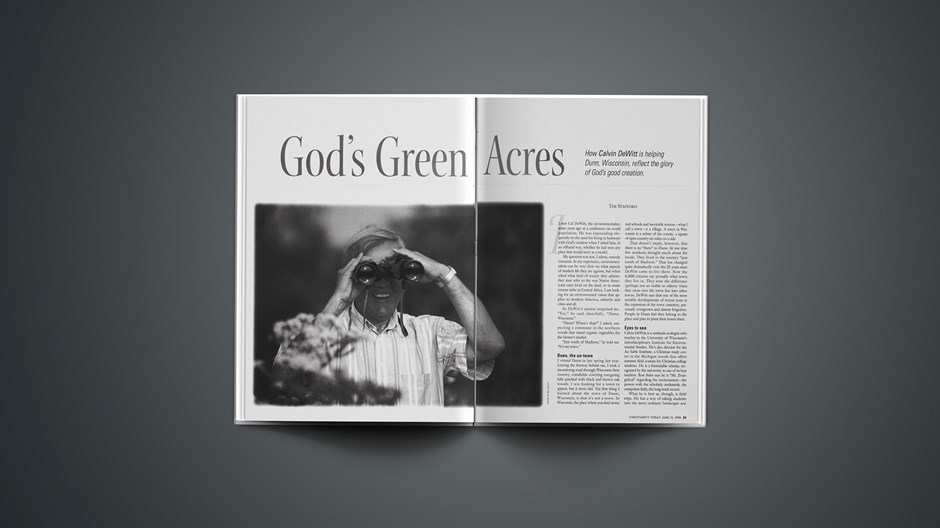
I met Cal DeWitt, the environmentalist, some years ago at a conference on world population. He was expounding eloquently on the need for living in harmony with God's creation when I asked him, in an offhand way, whether he had seen any place that would serve as a model.
My question was not, I admit, entirely innocent. In my experience, environmentalists can be very clear on what aspects of modern life they are against, but when asked what kind of society they admire, they may refer to the way Native Americans once lived on the land, or to some remote tribe in Central Africa. I am looking for an environmental vision that applies to modern America, suburbs and cities and all.
So DeWitt's answer surprised me. "Yes," he said cheerfully, "Dunn, Wisconsin."
"Dunn? Where's that?" I asked, suspecting a commune in the northern woods that raised organic vegetables for the farmer's market.
"Just south of Madison," he told me. "It's my town."
Dunn, the un-town
I visited Dunn in late spring last year. Leaving the freeway behind me, I took a meandering road through Wisconsin farm country, cornfields covering easygoing hills patched with black and brown oak woods. I was looking for a town to appear, but it never did. The first thing I learned about the town of Dunn, Wisconsin, is that it's not a town. In Wisconsin, the place where you find stores and schools and inevitable taverns—what I call a town—is a village. A town in Wisconsin is a subset of the county, a square of open country six miles on a side.
That doesn't imply, however, that there is no "there" to Dunn. At one time few residents thought much about the locale. They lived in the country "just south of Madison." That has changed quite dramatically over the 25 years since DeWitt came to live there. Now the 4,000 citizens say proudly what town they live in. They note the difference (perhaps not so visible to others) when they cross over the town line into other towns. DeWitt says that one of the most notable developments of recent years is the expansion of the town cemetery, previously overgrown and almost forgotten. People in Dunn feel they belong to the place and plan to plant their bones there.
Eyes to see
Calvin DeWitt is a wetlands ecologist who teaches in the University of Wisconsin's interdisciplinary Institute for Environmental Studies. He's also director for the Au Sable Institute, a Christian study center in the Michigan woods that offers summer field courses for Christian college students. He is a formidable scholar, recognized by the university as one of its best teachers. Ron Sider says he is "Mr. Evangelical" regarding the environment—the person with the scholarly credentials, the outspoken faith, the long track record.
What he is best at, though, is field trips. He has a way of taking students into the most ordinary landscapes and showing them a creation they hadn't seen. He is good at explaining complex features of the terrain and its living creatures, and he conveys a sense of wondering joy as he does it. DeWitt sees the world as a scientist and as a Christian, and he puts remarkably little space between those two. He is committed to preserving nature, but it isn't humanity against nature for him. Rather, he sees nature serving humanity by offering testimony to the glory of God.
It is one thing to proclaim God's glory on field trips. It is quite another in the vexed and politicized subject of land-use planning. Dunn's north boundary runs a mere stone's throw from Madison, a city that is spreading fast into the dairy, corn, and soybean farmland all around. When the DeWitts bought their home in 1972, the familiar process of turning farmland to suburb was well under way. Small subdivisions and five-acre "farmettes" were spreading across the landscape. Farmers whose children showed no interest in farming could foresee selling out to home builders for a bundle.
Calvin DeWitt sees the world
as a scientist and as a Christian,
and he puts remarkably
little space between the two.
DeWitt was studying rural land-use decisions and, as part of his research, went to observe a meeting of the Dunn town board, an elected council of three. The discussion was over a new hot-mix and rock-crushing plant that the town council had approved. Some of the neighbors were upset at the prospect of the plant polluting their environment, but the supervisors were in no mood to listen. One of them rudely told the dozen attendees that they were wasting time trying to argue the issue; if they didn't like the decision they should elect somebody else, but in the meantime, just go home.
DeWitt had come to observe, but these comments drove him to his feet. He spoke passionately to the small gathering on the nature of democracy. He spoke of an active, involved citizenry, not a passive electorate that votes every few years on who should make decisions for them.
The talk made an impression, and shortly thereafter he was invited to a meeting in a local farmer's living room. The purpose was to recruit a slate to run for the town board, to throw out the old, unresponsive supervisors. DeWitt was new to Dunn, but he was asked to stand for election.
Article continues below
DeWitt the politician
It is not easy to imagine Cal DeWitt running for elected office. He seems too idealistic for the grit of governance. "I often use Rembrandt for an illustration," he says. "Is it conceivable that we could give acclaim to the artist but not to his masterpieces? Is there anyone who honors Picasso without any reference to his paintings?" Our proper relation to God's creation is awe and wonder, DeWitt says. This does not sound like a land-use stump speech.
Once, he told me, he stopped his car on the Interstate freeway near Gary, Indiana, and tried to read Psalm 19 aloud. "I looked up into the night sky and couldn't see any stars because of all the lights and pollution. The noise of traffic was deafening. Semitrailers slammed by, literally sucking at my car. The psalm made no sense at all there. I thought, 'Here is a community that has been deprived, and has deprived itself, of nature's testimony.' "
DeWitt worries when human creation entirely supplants God's, when the natural world is so blotted out by city as to be unknown. He worries, too, about mental deprivation. "For some of my students, Star Trek is more real than the biosphere. They can tell you more about the starship Enterprise but don't know the boundaries of the town they live in. We even abstract nature in science, so it doesn't provide for awe and wonder."
In the world of politics, the Dunn town board sat very near the bottom of the food chain. Most planning decisions rested with the county. The town government was responsible for plowing snow and repairing local roads, and little else. Furthermore, many Dunn residents were vague on whether they lived within Dunn's boundaries, as their mail was addressed through one of the local villages. There was no cafe or post office where the people of Dunn gathered. Few paid attention to town elections.
Nevertheless, DeWitt approached his campaign with all the verve of a military assault. He helped mobilize a large pool of volunteers and dedicated himself to visiting every home in the town personally. He is an affable, easygoing conversationalist who treats even his enemies like old friends. His style of campaigning is perhaps best captured by his conversation with pike fishermen.
Some of Dunn's constituents, DeWitt explains, have settled in the area strictly for the pike. So, as DeWitt tells the story, he greets one such fisherman outside his home and asks cheerily, "How are things going with the pike nursery?"
Article continues below
The man looks confused, so DeWitt repeats the question.
"What's a pike nursery?" the fisherman asks.
"You like to catch pike?" DeWitt says. "I understand they get pretty big in this lake."
"Yeah, they do. Real big."
"Well," says DeWitt easily, "they don't start out that big. They start out as little ones. The place the little pike come from is what you call the pike nursery. I figured if you were a pike fisherman you would be able to tell me how things are going in the pike nursery."
The guy summons his neighbor, also a fisherman, and asks if he knows where pike come from. His neighbor doesn't know. DeWitt suggests they ask some more of their buddies. By now they're curious. Eventually there are eight pike fishermen standing around in the yard, none of whom knows where pike come from. So DeWitt explains that mature pike go into the marshes to spawn, and the little pike live in the shallow safety of the marshlands until they're big enough to venture out into the lake. That's one of the reasons DeWitt is running for town council, because the marshes are getting spoiled. If there isn't a marsh, there isn't a pike nursery; and without a pike nursery, there soon won't be any pike.
Needless to say, DeWitt won the pike-fisherman vote. He believes firmly that "when people really know their world, they will take care of it." A lot of his neighbors love the country—that's why they live in it—but they didn't really understand it. For DeWitt, loving the country and understanding its ecology go naturally together. His goal was not merely to win an election but to build a broad understanding of and involvement in town decisions.
The moratorium on development
DeWitt won his election and was able to scuttle the hot-mix plant. ("He did it with a filibuster," says supervisor Eleanor White. "Cal kept talking and talking. … He wore them down.")
Two years later, DeWitt was elected town chairman, and an ally, Ed Minihan, became a supervisor with him. Their two votes controlled the board, but it took some clever work for them to figure out how to use their power effectively. They learned that every new construction site needed town permission for access off the town roads. They used that as the choke point to control development.
There was a certain "last-one-in-close-the-door" quality to these restraints, as most of DeWitt's allies were recent arrivals from the city who wanted the countryside preserved as they had found it. Rosalind Gausman, who married into an old farm family, told me that DeWitt and his group were seen as "new people coming in and taking over our town. I had [Cal] pegged as an outsider and a troublemaker." Old-time farmers felt their property rights slipping away.
Article continues below
Their alarm grew when the town board slapped a two-year moratorium on all property subdivisions. Dunn had never had a land-use plan, and the continuing surge of applications for land divisions meant the council couldn't get its head above water. The debate was often framed in terms of development: Are you for or against it? But DeWitt noted that when people said "development," they only meant housing tracts. "We said, 'We're for development. We want to develop farms.' " They wanted Dunn to grow in a way that would make sense to its citizens and preserve the qualities that they loved. A moratorium would give them time to think through a plan.
Housing developers sued the town, which managed to survive through some good legal counsel and a $100,000 surplus built up by not building any roads for a year. Gausman says, "Cal is so amazing—how he could have a room full of hostile people, and he could calm the crowd. He would let them talk, would really try to understand them. Then he would start explaining his side. He would just calm things down. He always listens to people."
Prairie fire
DeWitt also likes to talk, and when he talks, his love for nature and his awe toward its splendors always comes through. When I first arrived in Dunn, Cal and Ruth DeWitt welcomed me to their home, set on a drumlin nearly surrounded by marsh. Cal was busy at his computer, manipulating images from a digital camera he had just acquired. He enthusiastically showed me how the software could be used to extract environmental data from a photograph of daffodils blooming on his lawn. Then, while Ruth prepared dinner, he walked me around the drumlin.
A drumlin, as DeWitt explained to me, is a cigar-shaped pile of rock and soil left by an ancient glacier. DeWitt pointed out the glacier's path, from Lake Waubesa just out of sight to the north, down the silver marsh at his front door, and on to Lake Kegonsa south and east. A mile away, on the other side of the marsh, ran a thin strip of black. "That's prairie," Cal said. "It's just been burned a few days ago." Fires are set in the marshlands at regular intervals, he explained, one section at a time, for both prairie and marsh depend on wildfire to sustain their balance.
Article continues below
Over dinner, we talked more about fire. "People ask me why I have a lawn around the house instead of prairie," Cal said. "I used to want to bring the prairie in a lot closer, but I learned that's not the most practical thing to do." He told how, lighting backfires to burn the grasslands on his property, he underestimated the power of wildfire. The fire department arrived just in time to save the house.
Suddenly Cal got up out of his seat, a look of excitement on his square, Dutch features. By his porch light, he pointed out the characteristic features of a burr oak tree growing near the door. A burr oak has thick, fire-resistant cork bark, which expresses itself in knife-edged ridges running up and down the trunk and along all but the thinnest branches. DeWitt took some time explaining this to me, telling me the relation of this oak tree to the cork trees of Spain, making me punch my fingers into the firm resiliency of the bark. I was not sure why he was excited until he began to talk about fire again.
"An oak savanna like this one is an island in the fire," he said, his voice full of awe. "When the marsh and prairie burn, the fire will usually peter out in the oak savanna, because the tall grasses don't grow in the shade of the trees. Occasionally, though, a fire will get into the crowns of the trees. The oak savanna would be destroyed except for the burr oak, which won't burn through. These cork ridges will light, and glow, but the heat won't penetrate to the life of the tree. If you see a burr oak after a wildfire you see every branch outlined in red, glowing with fire."
The budding naturalist
DeWitt grew up in Grand Rapids, Michigan, the child of devout Christian Reformed parents. His father was a house painter who encouraged his son to pursue whatever he loved. What Calvin loved was studying God's creatures. He had a pond in his back yard where he kept all nine species of Michigan turtles. He maintained a zoo with other wild creatures, including an extensive aquarium in the basement. Their home was on an ordinary 40-foot-wide city lot, but DeWitt used his bicycle to explore nearby fields and forests.
Educated in Christian Reformed schools, including nearby Calvin College, DeWitt never conceived of science as opposed to God. The book of nature was God's other book, a revelation of his nature.
When DeWitt went for doctoral studies at the University of Michigan, he expected a rigorous challenge to his faith, but he found that if his professors were materialists, they weren't dogmatically so. He was surprised to find a secular university such a congenial place for a Christian.
Article continues below
That's characteristic. Where others see sharp divisions, he finds it easy to unite his faith and his science. When it was popular in his field of ecology to blame Christianity for the degradation of the natural world, he established the Au Sable Institute with its explicitly Christian basis. He enthusiastically speaks of the Christian faculty and graduate students that he works with at the University of Wisconsin, a place hardly known as a bastion of faith.
DeWitt is reticent when asked his thoughts on evolution. He finds the whole discussion of origins very bookish, quite removed from the actual observation of God's handiwork. "Whatever God did is what God did. Whatever means he is using to create is okay with me," he says. Evolution has never been a cutting issue for him, he says. "Sometimes [it is] for two or three days, when I'm with people who think it is very important. Then I'm out in the field, singing psalms, enjoying God's marvelous work, and the discussion doesn't seem so significant."
Land-use
The plan for Dunn, Wisconsin, began with taking inventory. That's a natural approach for DeWitt. He hoped that when people got a firm understanding of their land, they would find that they mostly agreed on how to treat it. Taking inventory gave time to defuse the winners-and-losers mentality that land-use decisions often create.
A newly formed plan commission compiled a detailed description of their town's geology, water resources (including lakes, rivers, and streams), woodlands, wetlands, wildlife, fisheries, historic and cultural resources. They mapped bird flight patterns and assessed pollution in all surface water. They studied how locations for homes and businesses affect their surroundings. The University of Wisconsin and governmental authorities provided all kinds of expert testimony. Eventually, the town published their study so that every citizen could become familiar with the town's natural resources.
"Coming to know their place, they liked what they found and decided to care for it and keep it." That is DeWitt's published summary. The land-use plan the town wrote into law essentially tried to keep Dunn the way it is by severely limiting new subdivisions and businesses. It enabled property taxes for farms to be set on a basis that assumed agricultural use (rather than on a higher basis assuming the land's use for housing). Plans for parks and trails were made. Roadsides were replanted to prairie. Preserves were plotted out. And every detail of the plan assumed the active involvement of its citizens.
Article continues below
For example, community parks are planned and developed by the neighborhood they are in, not by a town parks department. Someone building a new home can live in a trailer on the property while he builds—to encourage families on a limited budget—but only if they personally get the okay from all their neighbors.
"We're for development,"
says DeWitt. "We
want to develop farms."
The plan, in fact, was adopted by a referendum, even though the town board had legal authority in itself. The idea was to involve as many citizens as possible in discussions about the plan.
You can certainly argue over the plan. By limiting building, the planners have made Dunn a kind of park land for Madison. Housing in Dunn is bound to grow expensive, simply by the law of supply and demand. Other locales will have to carry the burden of providing housing and jobs for a growing population. (Nearby villages will continue to expand, and Madison itself will push in other directions.) Dunn isn't everybody's solution.
Clearly, though, it's the favored plan of the people of Dunn. In the early days there were lawsuits and meetings where people shouted, and one election where the reformers were voted out of office. (Two years later they were voted back in.) In recent elections, there hasn't even been opposition. Most of the old-time farmers have come to see that, as town clerk Rosalind Gausman says, "these guys are not out for their own good." In fact, one of the clearest objectives of the Dunn plan is to create conditions where farming can be a viable way of life forever.
In a 1996 referendum, Dunn voted to raise its taxes, the money to be used to purchase development rights for crucial parcels of land. The idea is to lock in the land-use plan permanently. It helped that a frugal approach to town government had kept their taxes lower than anywhere else in the area.
User-friendly environment
I concluded a day-long tour of Dunn standing with DeWitt in a small oak grove overlooking the northwest corner of the town. Looking north, we could just make out a ribbon of cars and trucks moving on the Madison beltway. Otherwise, the scene was an American pastoral, now preserved permanently as farmland and park. Through complicated negotiations, Dunn officials had succeeded in using their new tax dollars to buy a large tract of the land there, then reselling it, stripped of its development rights, to a local farmer. DeWitt told me about the pig farmer who had increased his farm's economic viability, about the heirs of a large tract who had agreed to sell to the town for a reduced price, and about others involved in delicate financial negotiations. Just a few days before, the town had celebrated with a picnic on the grounds where we stood.
Article continues below
I noticed a stand of small conifers, aliens in the landscape, growing on the northern edge of the oak grove. I asked DeWitt whether they would be removed.
"No," he said. "If we were the Nature Conservancy [an environmental preservation group, which has bought land for preservation in nearby marshes] the conifers would go, because they aren't indigenous. But they make a good wind screen for picnickers, so we'll leave them."
In a small way, that captures DeWitt's philosophy. He's not such a purist that human concerns have to get out of nature's way. Rather, he seeks ways for the natural world and the human world to live as neighbors. That's good for the natural creation, because when humans live with it and get to know it, they love it and want to take care of it. And it's good for humans, because through the natural world they get a dose of the reality of God's reign. Community is a natural result. Picnics—an expression of community—are a result. DeWitt takes a serious interest in picnics.
Lessons learned
DeWitt really thinks we can find common ground between environmental concerns and humanity's needs when we experience the creation (as distinct from arguing about it). That's why, in his university classroom, his chief objectives are "awe and wonder" and "developing community." He takes his students on field trips to develop both. He believes, in fact, that the natural world offers the best resource for saving the university from its factionalism, its rigidity, its inhumanity.
It's the same with Dunn. People scattered in a country setting, commuting elsewhere, often live isolated lives. Dunn has no gathering place where they bump into neighbors—not even a school. (Dunn's children go to school in nearby villages.) Yet Dunn's environment brought its citizens together. Through the long, ongoing process of figuring out how to care for Dunn and to keep it, they came to know and value each other.
Does Dunn offer anything to the rest of America, cities and suburbs and all? Two things, I believe. First, it reminds us that God's beautiful creation can exist harmoniously on the very border of a large city. Madison will have Wisconsin marsh and farm a bike ride away, perpetually.
Article continues below
Second, it suggests that the beauty around us really can help us find common ground. Not, of course, that decisions about the land are easy to make. Differing political and economic ideas, applied to the environment, can make for heated combat. Yet when people take a break from arguing and actually look at the world God has made, they generally want to keep it and care for it. It's a rare person who doesn't value parks, whether they are as grand as Yellowstone or as ordinary as a prairie path reclaimed from an old railroad. It's a rare person who feels no sense of loss in seeing condos line the Gulf Coast, or hearing of the extinction of any species. Dunn, Wisconsin, is one small example of how people can come together around such deep, instinctive responses. It is an example not just of preserving nature. It is also people and community who are being preserved.
















 While we pray for peace, we need moral clarity about this war.
 Church movements need magnetic leaders. But the best leaders need more than charm.
 American Bible Society study finds majority don’t trust technology with spiritual matters.