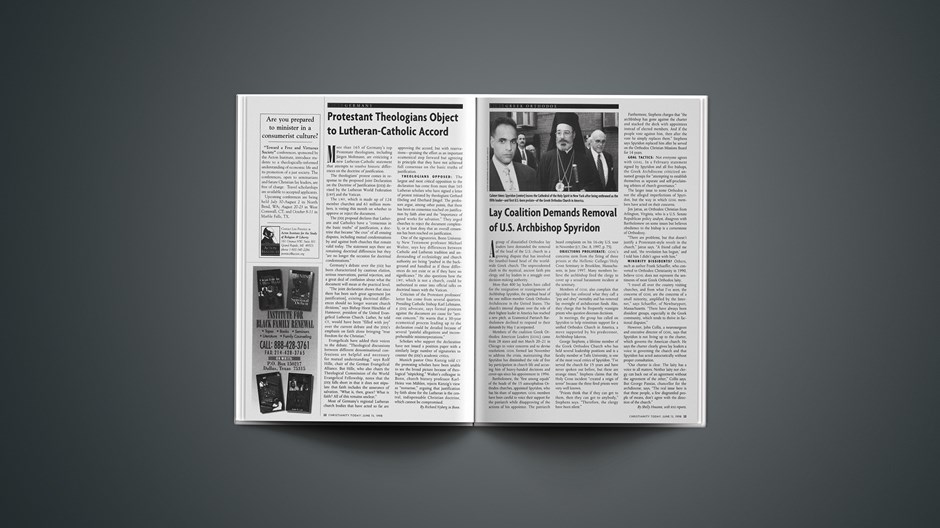
A group of dissatisfied Orthodox lay leaders have demanded the removal of the head of the U.S. church in a growing dispute that has involved the Istanbul-based head of the worldwide Greek church. The unprecedented clash in the mystical, ancient faith pits clergy and lay leaders in a struggle over decision-making authority.
More than 400 lay leaders have called for the resignation or reassignment of Archbishop Spyridon, the spiritual head of the one million-member Greek Orthodox Archdiocese in the United States. The church's internal dispute over the role of their highest leader in America has reached a new pitch, as Ecumenical Patriarch Bartholomew declined to respond to their demands by May 1 as requested.
Members of the coalition Greek Orthodox American Leaders (GOAL) came from 28 states and met March 20-21 in Chicago to voice concerns and to devise resolutions. GOAL formed last November to address the crisis, maintaining that Spyridon has diminished the role of free lay participation in church life and accusing him of heavy-handed decisions and cover-ups since his appointment in 1996.
Bartholomew, the "first among equals" of the heads of the 15 autocephalous Orthodox churches, appointed Spyridon, who has his share of supporters. GOAL members have been careful to voice their support for the patriarch while disapproving of the actions of his appointee. The patriarch heard complaints on his 16-city U.S. tour in November (CT, Dec. 8, 1997, p. 75).
OBJECTIONS PROLIFERATE: GOAL's concerns stem from the firing of three priests at the Hellenic College/Holy Cross Seminary in Brookline, Massachusetts, in June 1997. Many members believe the archbishop fired the clergy to cover up a sexual harassment incident at the seminary.
Members of GOAL also complain that Spyridon has enforced what they call a "pay and obey" mentality and has removed lay oversight of archdiocesan funds. Also, they charge that he frequently reassigns priests who question diocesan decisions.
In meetings, the group has called on Spyridon to help reinstitute support for a unified Orthodox Church in America, a move supported by his predecessor, Archbishop Iakovos.
George Stephens, a lifetime member of the Greek Orthodox Church who has held several leadership positions and is a faculty member at Tufts University, is one of the most vocal critics of Spyridon. "I've served the church for 15 years and have never spoken out before, but these are strange times." Stephens claims that the Holy Cross incident "created a reign of terror" because the three fired priests were very well known.
"Priests think that if they can get to them, then they can get to anybody," Stephens says. "Therefore, the clergy have been silent."
Furthermore, Stephens charges that "the archbishop has gone against the charter and stacked the deck with appointees instead of elected members. And if the people vote against him, then after the vote he simply replaces them." Stephens says Spyridon replaced him after he served on the Orthodox Christian Missions Board for 14 years.
GOAL TACTICS: Not everyone agrees with GOAL. In a February statement signed by Spyridon and all five bishops, the Greek Archdiocese criticized unnamed groups for "attempting to establish themselves as separate and self-proclaiming arbiters of church governance."
The larger issue to some Orthodox is not the alleged imperfections of Spyridon, but the way in which GOAL members have acted on their concerns.
Jim Jatras, an Orthodox Christian from Arlington, Virginia, who is a U.S. Senate Republican policy analyst, disagrees with Bartholomew on some issues but believes obedience to the bishop is a cornerstone of Orthodoxy.
"There are problems, but that doesn't justify a Protestant-style revolt in the church," Jatras says. "A friend called me and said, 'the revolution has begun,' and I told him I didn't agree with him."
MINORITY DISSIDENTS? Others, such as author Frank Schaeffer, who converted to Orthodox Christianity in 1990, believe GOAL does not represent the sentiments of most Greek Orthodox laity.
"I travel all over the country visiting churches, and from what I've seen, the concerns of GOAL are the concerns of a small minority, amplified by the Internet," says Schaeffer, of Newburyport, Massachusetts. "There have always been dissident groups, especially in the Greek community, which tends to thrive in factional disputes."
However, John Collis, a neurosurgeon and executive director of GOAL, says that Spyridon is not living up to the charter, which governs the American church. He says the charter clearly gives lay leaders a voice in governing the church and that Spyridon has acted autocratically without proper consultation.
"Our charter is clear. The laity has a voice in all matters. Neither laity nor clergy can back out of an agreement without the agreement of the other," Collis says. But George Passias, chancellor for the archdiocese, says, "The real issue here is that these people, a few disgruntled people of means, don't agree with the direction of the church."














 While we pray for peace, we need moral clarity about this war.
 But let’s not mistake it for calling.
 American Bible Society study finds majority don’t trust technology with spiritual matters.