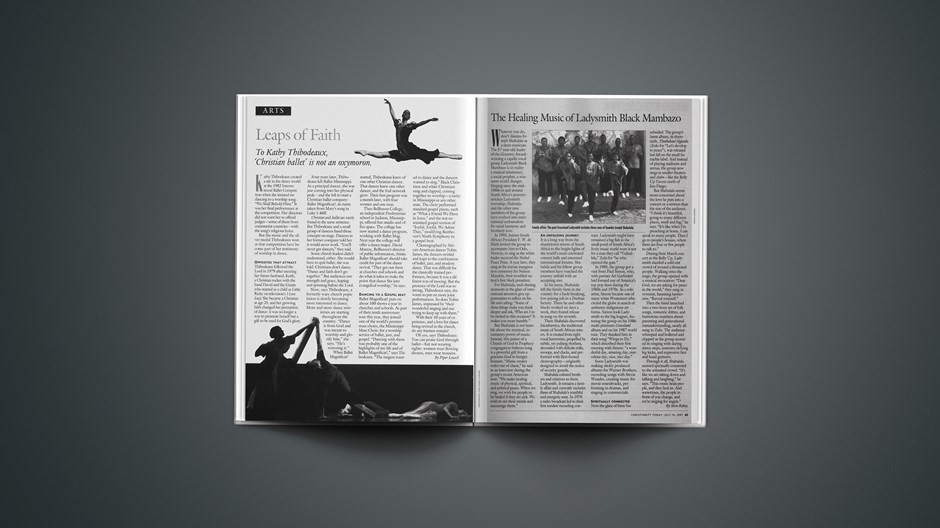
The Healing Music of Ladysmith Black Mambazo
Whatever you do, don't dismiss Joseph Shabalala as a mere musician. The 57-year-old leader of the Grammy Award-winning a capella vocal group Ladysmith Black Mambazo is in reality a musical missionary, a social prophet, a winsome world changer. Singing since the mid-1960s in and around South Africa's poverty-stricken Ladysmith township, Shabalala and the other nine members of the group have evolved into international ambassadors for racial harmony and brotherly love.
In 1993, former South African President F. W. de Klerk invited the group to accompany him to Oslo, Norway, to sing as the white leader received the Nobel Peace Prize. A year later, they sang at the joyous inauguration ceremony for Nelson Mandela, their troubled nation's first black president.
For Shabalala, such shining moments in the glare of international attention give opportunities to reflect on his life and calling: "Some of these things make you think deeper and ask, 'Who am I to be invited to this occasion?' It makes you more humble."
But Shabalala is not humble about the mystical, incantatory power of music. Instead, this pastor of a Church of God in Prophecy congregation believes song is a powerful gift from a gracious God to hungry humans. "Music creates order out of chaos," he said in an interview during the group's recent American tour. "We make healing music of physical, spiritual, and political peace. When we sing, we wish for people to be healed if they are sick. We wish to stir their minds and encourage them."
AN UNFOLDING JOURNEY
It is a long way from the shantytown streets of South Africa to the bright lights of the world's most celebrated concert halls and esteemed international forums. Shabalala and his fellow group members have watched the journey unfold with an accepting awe.
In his teens, Shabalala left the family farm in the country for a back-breaking, low-paying job in a Durban factory. There he and other blacks worked six days a week, then found release in song on the seventh.
There Shabalala discovered Isicathamiya, the traditional music of South African miners. It is created from tight vocal harmonies, propelled by subtle, yet pulsing rhythms, decorated with delicate trills, swoops, and clucks, and performed with a fleet-footed choreography-originally designed to avoid the notice of security guards.
Shabalala enlisted both brothers and relatives to form Ladysmith. It remains a family affair and currently includes three of Shabalala's youthful and energetic sons. In 1970 a radio broadcast led to their first modest recording contract. Ladysmith might have remained a big fish in the small pond of South Africa's lively music world were it not for a man they call "Vulindlela," Zulu for "he who opened the gate."
In 1985, the group got a visit from Paul Simon, who, with partner Art Garfunkel had formed one of America's top duos during the 1960s and 1970s. As a solo artist, Simon became one of many white Westerners who circled the globe in search of authentic indigenous art forms. Simon took Ladysmith to the big leagues, featuring the group on his 1986 multi-platinum Graceland album and on his 1987 world tour. They thanked him in their song "Wings to Fly," which described their first meeting with Simon: "a wonderful day, amazing day, marvelous day, nice, nice day."
Soon Ladysmith was making slickly produced albums for Warner Brothers, recording songs with Stevie Wonder, creating music for movie soundtracks, performing dramas, and singing in commercials.
SPIRITUALLY CONNECTED
Now the glare of fame has subsided. The group's latest album, its thirty-sixth, Thuthukani Ngoxolo (Zulu for "Let's develop in peace") was released last fall on the small Sanachie label. And instead of playing stadiums and arenas, the group now sings in smaller theaters and clubs-like the Belly Up Tavern north of San Diego.
But Shabalala seems more concerned about the love he puts into a concert or a sermon than the size of the audience. "I think it's beautiful, going to many different places, small and big," he says. "It's like when I'm preaching at home, I can speak to many people. Then I go to people's houses, where there are four or five people to talk to."
During their March concert at Belly Up, Ladysmith dazzled a sold-out crowd of around a thousand people. Walking onto the stage, the group opened with a musical invocation: "Dear God, we are asking for peace in the world," they sang in reverent, haunting harmonies. "Reveal yourself."
Then the band launched into a two-hour set of folk songs, romantic ditties, and humorous numbers about parenting and generational misunderstanding, nearly all sung in Zulu. The audience whooped and hollered and clapped as the group accented its singing with daring dance steps, anatomy-defying leg kicks, and expressive face and hand gestures.
Through it all, Shabalala seemed spiritually connected to the animated crowd. "It's like we are sitting down and talking and laughing," he says. "This music heals people, and they heal us. And sometimes, the people in front of you change, and we're singing for angels."
By Steve Rabey
Christianity Today: July 14, 1997 p. 45
The Healing Music of Ladysmith Black Mambazo
Whatever you do, don't dismiss Joseph Shabalala as a mere musician. The 57-year-old leader of the Grammy Award-winning a capella vocal group Ladysmith Black Mambazo is in reality a musical missionary, a social prophet, a winsome world changer. Singing since the mid-1960s in and around South Africa's poverty-stricken Ladysmith township, Shabalala and the other nine members of the group have evolved into international ambassadors for racial harmony and brotherly love.
In 1993, former South African President F. W. de Klerk invited the group to accompany him to Oslo, Norway, to sing as the white leader received the Nobel Peace Prize. A year later, they sang at the joyous inauguration ceremony for Nelson Mandela, their troubled nation's first black president.
For Shabalala, such shining moments in the glare of international attention give opportunities to reflect on his life and calling: "Some of these things make you think deeper and ask, 'Who am I to be invited to this occasion?' It makes you more humble."
But Shabalala is not humble about the mystical, incantatory power of music. Instead, this pastor of a Church of God in Prophecy congregation believes song is a powerful gift from a gracious God to hungry humans. "Music creates order out of chaos," he said in an interview during the group's recent American tour. "We make healing music of physical, spiritual, and political peace. When we sing, we wish for people to be healed if they are sick. We wish to stir their minds and encourage them."
AN UNFOLDING JOURNEY
It is a long way from the shantytown streets of South Africa to the bright lights of the world's most celebrated concert halls and esteemed international forums. Shabalala and his fellow group members have watched the journey unfold with an accepting awe.
In his teens, Shabalala left the family farm in the country for a back-breaking, low-paying job in a Durban factory. There he and other blacks worked six days a week, then found release in song on the seventh.
There Shabalala discovered Isicathamiya, the traditional music of South African miners. It is created from tight vocal harmonies, propelled by subtle, yet pulsing rhythms, decorated with delicate trills, swoops, and clucks, and performed with a fleet-footed choreography-originally designed to avoid the notice of security guards.
Shabalala enlisted both brothers and relatives to form Ladysmith. It remains a family affair and currently includes three of Shabalala's youthful and energetic sons. In 1970 a radio broadcast led to their first modest recording contract. Ladysmith might have remained a big fish in the small pond of South Africa's lively music world were it not for a man they call "Vulindlela," Zulu for "he who opened the gate."
In 1985, the group got a visit from Paul Simon, who, with partner Art Garfunkel had formed one of America's top duos during the 1960s and 1970s. As a solo artist, Simon became one of many white Westerners who circled the globe in search of authentic indigenous art forms. Simon took Ladysmith to the big leagues, featuring the group on his 1986 multi-platinum Graceland album and on his 1987 world tour. They thanked him in their song "Wings to Fly," which described their first meeting with Simon: "a wonderful day, amazing day, marvelous day, nice, nice day."
Soon Ladysmith was making slickly produced albums for Warner Brothers, recording songs with Stevie Wonder, creating music for movie soundtracks, performing dramas, and singing in commercials.
SPIRITUALLY CONNECTED
Now the glare of fame has subsided. The group's latest album, its thirty-sixth, Thuthukani Ngoxolo (Zulu for "Let's develop in peace") was released last fall on the small Sanachie label. And instead of playing stadiums and arenas, the group now sings in smaller theaters and clubs-like the Belly Up Tavern north of San Diego.
But Shabalala seems more concerned about the love he puts into a concert or a sermon than the size of the audience. "I think it's beautiful, going to many different places, small and big," he says. "It's like when I'm preaching at home, I can speak to many people. Then I go to people's houses, where there are four or five people to talk to."
During their March concert at Belly Up, Ladysmith dazzled a sold-out crowd of around a thousand people. Walking onto the stage, the group opened with a musical invocation: "Dear God, we are asking for peace in the world," they sang in reverent, haunting harmonies. "Reveal yourself."
Then the band launched into a two-hour set of folk songs, romantic ditties, and humorous numbers about parenting and generational misunderstanding, nearly all sung in Zulu. The audience whooped and hollered and clapped as the group accented its singing with daring dance steps, anatomy-defying leg kicks, and expressive face and hand gestures.
Through it all, Shabalala seemed spiritually connected to the animated crowd. "It's like we are sitting down and talking and laughing," he says. "This music heals people, and they heal us. And sometimes, the people in front of you change, and we're singing for angels."
By Steve Rabey
Christianity Today: July 14, 1997 p. 45
Have something to add about this? See something we missed? Share your feedback here.
Our digital archives are a work in progress. Let us know if corrections need to be made.















 While we pray for peace, we need moral clarity about this war.
 How Jesus rescued a New Age psychic from spiritual darkness.
 For all his greatness, we should most seek to imitate the late pastor’s humility and indifference to fame.