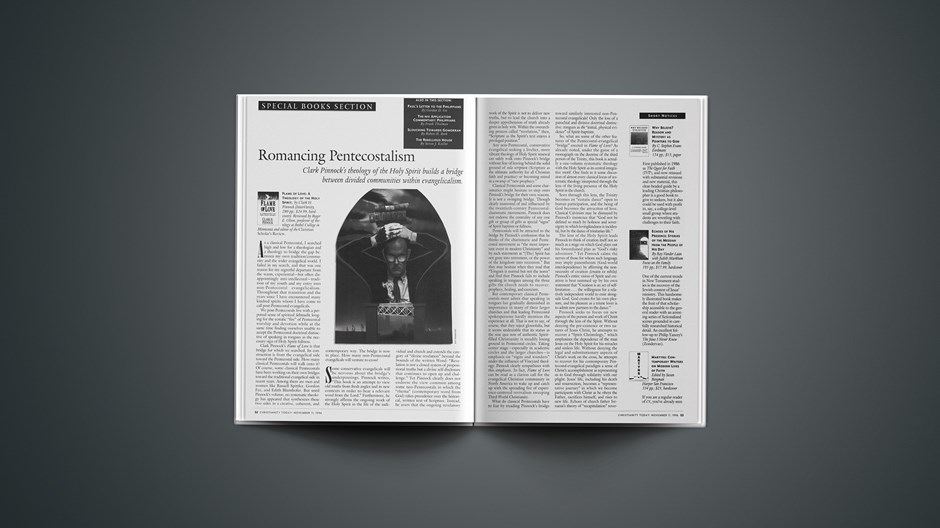
Flame of Love: A Theology of the Holy Spirit,by Clark H. Pinnock (InterVarsity, 280 pp.; $24.99, hardcover). Reviewed by Roger E. Olson, professor of theology at Bethel College in Minnesota and editor of the Christian Scholar's Review.
As a classical Pentecostal, I searched high and low for a theologian and a theology to bridge the gap between my own tradition/community and the wider evangelical world. I failed in my search, and that was one reason for my regretful departure from the warm, experiential—but often disappointingly anti-intellectual—tradition of my youth and my entry into non-Pentecostal evangelicalism. Throughout that transition and the years since I have encountered many kindred spirits whom I have come to call post-Pentecostal evangelicals.
We post-Pentecostals live with a perpetual sense of spiritual Sehnsucht, longing for the ecstatic "fire" of Pentecostal worship and devotion while at the same time finding ourselves unable to accept the Pentecostal doctrinal distinctive of speaking in tongues as the necessary sign of Holy Spirit fullness.
Clark Pinnock's Flame of Love is that bridge for which we searched. Its construction is from the evangelical side toward the Pentecostal side. How many classical Pentecostals will walk onto it? Of course, some classical Pentecostals have been working on their own bridges toward the traditional evangelical side in recent years. Among them are men and women like Russell Spittler, Gordon Fee, and Edith Blumhofer. But until Pinnock's volume, no systematic theology has appeared that synthesizes these two sides in a creative, coherent, and contemporary way. The bridge is now in place. How many non-Pentecostal evangelicals will venture to cross?
Some conservative evangelicals will be nervous about the bridge's underpinnings. Pinnock writes, "This book is an attempt to view old truths from fresh angles and in new contexts in order to hear a relevant word from the Lord." Furthermore, he strongly affirms the ongoing work of the Holy Spirit in the life of the individual and church and extends the category of "divine revelation" beyond the bounds of the written Word: "Revelation is not a closed system of propositional truths but a divine self-disclosure that continues to open up and challenge." Yet Pinnock clearly does not endorse the view common among some neo-Pentecostals in which the "rhema" (contemporary word from God) takes precedence over the historical, written text of Scripture. Instead, he avers that the ongoing revelatory work of the Spirit is not to deliver new truths, but to lead the church into a deeper apprehension of truth already given in holy writ. Within the overarching process called "revelation," then, "Scripture as the Spirit's text enjoys a privileged position."
Any non-Pentecostal, conservative evangelical seeking a livelier, more vibrant theology of Holy Spirit renewal can safely walk onto Pinnock's bridge without fear of leaving behind the solid ground of sola scriptura (Scripture as the ultimate authority for all Christian faith and practice) or becoming mired in a swamp of "new prophecy."
Classical Pentecostals and some charismatics might hesitate to step onto Pinnock's bridge for their own reasons. It is not a swinging bridge. Though clearly enamored of and influenced by the twentieth-century Pentecostal-charismatic movements, Pinnock does not endorse the centrality of any one gift or group of gifts as special "signs" of Spirit baptism or fullness.
Pentecostals will be attracted to the bridge by Pinnock's confession that he thinks of the charismatic and Pentecostal movement as "the most important event in modern Christianity" and by such statements as "[The] Spirit has not gone into retirement, or the power of the kingdom into recession." But they may hesitate when they read that "Tongues is normal but not the norm" and find that Pinnock fails to include speaking in tongues among the three gifts the church needs to recover: prophecy, healing, and exorcism.
But contemporary classical Pentecostals must admit that speaking in tongues has gradually diminished in importance in many of their larger churches and that leading Pentecostal spokespersons hardly mention the experience at all. That is not to say, of course, that they reject glossolalia, but it seems undeniable that its status as the sine qua non of authentic Spirit-filled Christianity is steadily losing ground in Pentecostal circles. Taking center stage—especially in academic circles and the larger churches—is emphasis on "signs and wonders" under the influence of Vineyard theology. Pinnock clearly sympathizes with this emphasis. In fact, Flame of Love can be read as a clarion call for the evangelical Christian community in North America to wake up and catch up with the spreading fire of experience-centered revivalism sweeping Third World Christianity.
What do classical Pentecostals have to fear by treading Pinnock's bridge toward similarly interested non-Pentecostal evangelicals? Only the loss of a parochial and divisive doctrinal distinctive: tongues as the "initial, physical evidence" of Spirit-baptism.
Article continues below
So, what are some of the other features of the Pentecostal-evangelical "bridge" erected in Flame of Love? As already noted, under the guise of a monograph on the doctrine of the third person of the Trinity, this book is actually a one-volume systematic theology with the Holy Spirit as its central integrative motif. One finds in it some discussion of almost every classical locus of systematic theology interpreted through the lens of the living presence of the Holy Spirit in the church.
Seen through this lens, the Trinity becomes an "ecstatic dance" open to human participation, and the being of God becomes the attraction of love. Classical Calvinists may be dismayed by Pinnock's insistence that "God not be defined so much by holiness and sovereignty in which lovingkindness is incidental, but by the dance of trinitarian life."
The lens of the Holy Spirit leads Pinnock to think of creation itself not so much as a stage on which God plays out his foreordained plan as "God's risky adventure." Yet Pinnock calms the nerves of those for whom such language may imply panentheism (God-world interdependence) by affirming the nonnecessity of creation (creatio ex nihilo). Pinnock's entire vision of Spirit and creation is best summed up by his own statement that "Creation is an act of self-limitation … the willingness for a relatively independent world to exist alongside God. God creates for his own pleasure, and his pleasure as a triune lover is to admit new partners to the dance."
Pinnock seeks to focus on new aspects of the person and work of Christ through the lens of the Spirit. Without denying the pre-existence or two natures of Jesus Christ, he attempts to recover a "Spirit Christology," which emphasizes the dependence of the man Jesus on the Holy Spirit for his miracles and sinless life. Without denying the legal and substitutionary aspects of Christ's work on the cross, he attempts to recover for his contemporary Pentecostal-evangelical paradigm a sense of Christ's accomplishment as representing us to God through solidarity with our plight. Jesus' life, including his death and resurrection, becomes a "representative journey" in which we become participants with Christ as he obeys the Father, sacrifices himself, and rises to new life. Echoes of church father Irenaeus's theory of "recapitulation" reverberate through Pinnock's account of Christ as the "new Adam" who gives humanity a fresh start in the power of the Holy Spirit.
Article continues below
A major portion of Flame of Love is devoted to the question of the Holy Spirit's work outside the Christian community. A basic thesis-continuous with Pinnock's earlier work A Wideness in God's Mercy (Zondervan)—is that the "Spirit is not confined to the church but is present everywhere, giving life and creating community." Pinnock appeals to John Wesley and C. S. Lewis as precursors of his own view of the universality of the Spirit's operation. He explicitly rejects universalism of salvation, calling his own view "a modest proposal" by comparison. In order to clarify his own view—misunderstood by some critics of his earlier work—he explains that the Spirit does not work salvifically through non-Christian religions as vehicles of grace. At the same time, however, he affirms with Wesley and Lewis that God's Spirit cannot be limited to speaking only within the narrow confines of Christianity, but must be allowed the freedom to speak to anyone anywhere and at any time who has "ears to hear."
While there is no doubt that Pinnock denies universalism and affirms the uniqueness and finality of Jesus Christ, it seems at times that he desperately wishes God be an equal opportunity savior. Sound theological reflection may lead him to write that "No nook or cranny [of creation] is untouched by the finger of God. His warm breath streams toward humanity with energy and life." But only wishful thinking can lead him to claim that "God is a serious lover who does not allow persons to perish without any opportunity to respond to his love."
The greatest weakness of Flame of Love is flowery theological overstatement. But one gets the impression that Pinnock is attempting not to write another dry-as-dust, scholastic summary of all propositional truth, many of which already crowd the shelves of theological libraries and used-book stores. Flame of Love is one man's reflection on the dynamic presence and power of the Holy Spirit and is at least less wild than the Spirit himself.















 While we pray for peace, we need moral clarity about this war.
 How Jesus rescued a New Age psychic from spiritual darkness.
 A majority of American Protestants were raised by devout mothers, a study finds.